

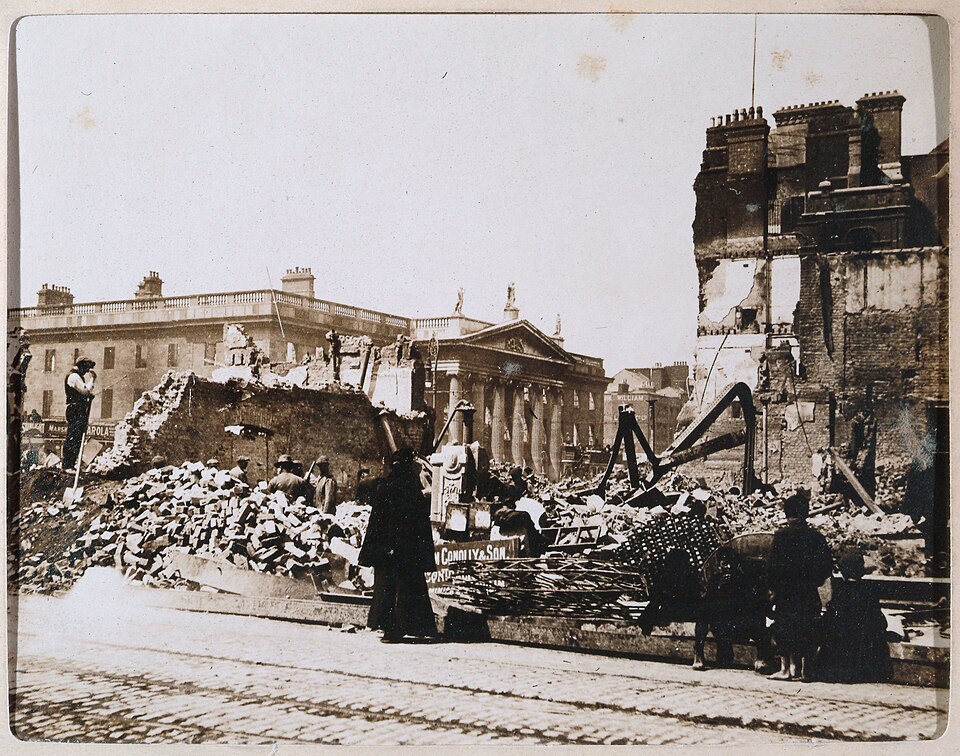
One hundred ten years ago yesterday, on a Monday, the Irish Volunteers along with the Irish Republican Brotherhood took over the General Post Office on Sackville Street in Dublin. Patrick Pearse read the Proclamation of the Irish Republic, and the city spent the next five days under siege as a small force of Republican fighters took on the British army.
The Rising was initially a failure. The rebels agreed to an unconditional surrender, their leaders executed within a month. But it planted the seed of a larger independence movement, and six years later, after the War of Independence, most of Ireland became free of the United Kingdom.
How did the Easter Rising differ from earlier fights for independence? I asked this question of our tour guide on the 1916 Rebellion Walking Tour of Dublin when my family visited Ireland in 2022. The guide said that it was the background of the Rising’s leaders that led to a reckoning. The men who led the fight and were executed by the British were not soldiers or military men:
They were poets, and teachers, and lawyers — ordinary people willing to die for a noble cause. Patrick Pearse, the leader and author of the Proclamation, ran a boy’s school that taught Irish language and history. James Connolly, a labor activist who was gravely wounded in the fighting, was so ill from his wounds that he was driven by ambulance to the yard at Kilmainham Gaol, where officers placed him in a chair and shot him.
What does this have to do with the events of “Banshee?”
Absolutely nothing. But the Easter Rising is not just a pivotal moment in Irish history; it’s the signature event that kicked off my obsession with Irish history, politics and culture. Without my parents teaching me this history, and playing countless Clancy Brothers records filled with rebel songs of 1916, “Banshee” might not exist.
Obsession patient zero, if you like.
A cynic could dismiss the Easter Rising as a lost cause in the battle for independence, not unlike the 1798 Rebellion — which is very much a part of the world in which “Banshee” is set. History does not take place in isolation; events of the past inform the actions of the future. Wolfe Tone, the leader of the United Irishmen in 1798, drew inspiration from the American Revolution. Patrick Pearse and his compatriots likewise were influenced by the rebellion more than a century previous.
Even though the Easter Rising gets no mention in “Banshee,” this theme of the past informing the future is a huge part of the story.
In case you’re wondering, yes I do have a play about the Easter Rising. It’s called “Rebel Chocolates” and it’s available to read for New Play Exchange members.
In the meantime, “Banshee” is opening in six days. If you are in the Reading area, tickets are available on Reading Theater Project’s ticketing site.
 Adam-Richter.com
Leave a comment