

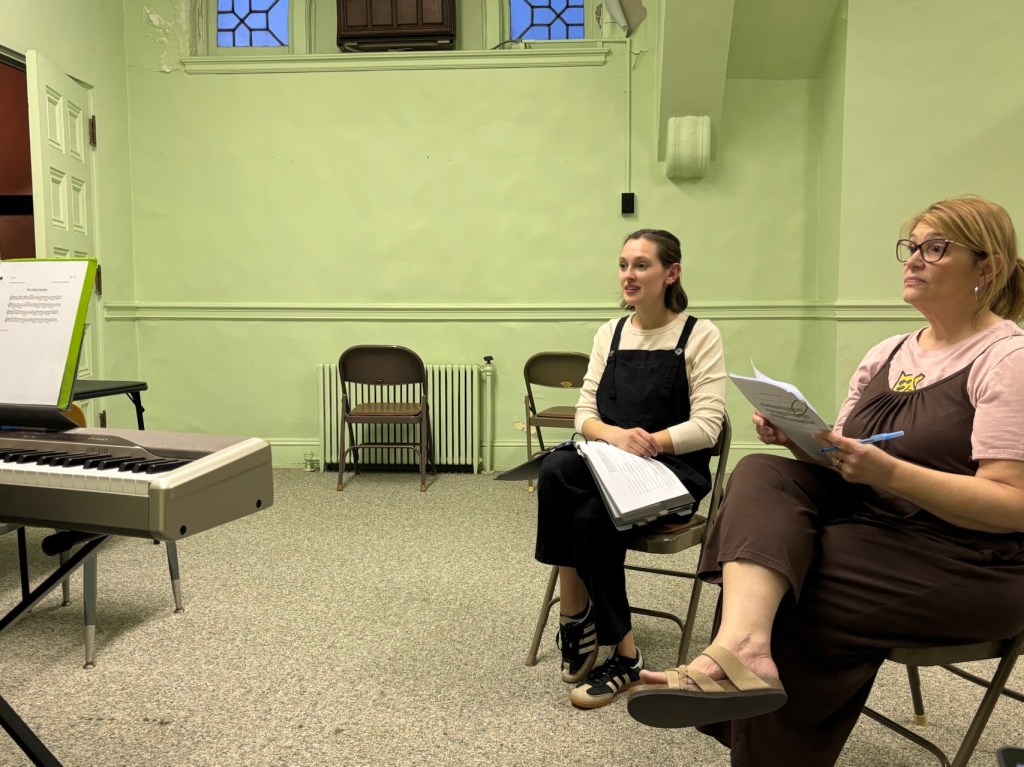
Last night’s “Banshee” rehearsal felt different.
All of a sudden, this whole thing seems real.
The play has been through table reads, one public reading and multiple rehearsals on its way to its full production in May.
Along the way, it has mutated and grown, but always felt like “this nice thing I’ve written” more than something that will come to life.
But last night, we worked with music.
“Banshee” no longer seems abstract.
For context: Since the play’s inception I have incorporated a few songs and musical interludes into the script. “Banshee” is not a musical — if it were, I would have titled it “BANSHEE!” — but it has musical elements that were, before now, treated as secondary to the script.
In table reads — even the public reading about two years ago — the music was never considered more than an optional stage direction. The songs were spoken, never sung.
As a result, the lyrics were the one part of the script I left mostly untouched throughout the revision process. I always figured, “I’ll deal with that when the time comes.”
The time came, last night. Emily Fredericks, a music teacher, worked with the actors playing Nancy (Andrea Keck) and the Banshee (Karyn Reppert) on the music, teaching them the two main melodies in the play.
One is a wordless song performed by the Banshee, found in William Butler Yeats’ “Irish Folk and Fairy Tales.” The other is an Irish jig to which I set the lyrics for the three songs in the play.
Why did I write lyrics to a jig? Because I am both a sadist and a massochist.
Emily also helped figure out the weak spots in the song, allowing me to rewrite the lyrics to fit the music. I am the furthest thing from a musician but fortunately Emily has the patience of a — well, of a music teacher — and we were able to work out the kinks.
Could I have written the play without music? Sure.
Could I have written the Banshee’s lines in prose instead of adapting the Dán Díreach verse form for her speech? Absolutely.
But the play would have suffered for it. The language of myth is poetry, not prose. As I was researching the stories around the banshee, I found multiple prose versions. Irish ballads provide a rich vein of faerie stories, including the Banshee. One of my favorites is “Earl Desmond and the Banshee,” about a man who tries to outrun the creature only to discover his new bride has died:
(That’s not a spoiler; the poem is hundreds of years old.)
To pass that oak in vain he tried
His steed refused to stir,
Though furious ’gainst his panting side
Was struck the bloody spur.
The moon, by driving clouds o’ercast
Withheld its fitful gleam
And louder than the tempest blast
Was heard the Banshee’s scream.
— From “The Ballads of Ireland,” ed. Edward Hayes, retrieved from archive.org
Poetry is in the DNA of Ireland’s culture. While I’m not vain enough to say that “Banshee” continues the tradition, I am at least hopeful that the play honors it.
“Banshee” runs May 1-10 at the WCR Center for the Arts in Reading, Pa. Tickets are available here.
 Adam-Richter.com
Leave a comment